Squiggling & Visual Storytelling Activity
Hato Builiko workshop
We arrived in Hato Builiko in the afternoon. The road was very rough and we saw 2 minor bike accidents on the way. The workshop was planned for the following day, however the priest who had publicised and promoted the workshop had been caught up in Dili and would not be there.
The visual storytelling workshop was designed to demonstrate and foster storytelling through drawing and graphic novel conventions. It is a fun, effective way to start the conversation around small and big issues in a community. The problems that face remote or marginalised communities like Hato Builiko are often complex or taboo. Whether it is highlighting many of the issues arising from climate change or other inequities that result in political or domestic violence, the workshop is customised to suite the location, audience and aims of the community.
The workshop begins with a Squiggle activity designed to be a creative thinking warm-up exercise. It provides an easy entry point to using drawing and graphic novel devices to communicate and connect with people of different ages and cultural backgrounds. It sprung from an assessment task designed for first-year undergraduate students enrolled in a subject called Visual Storytelling at Western Sydney University, Australia.
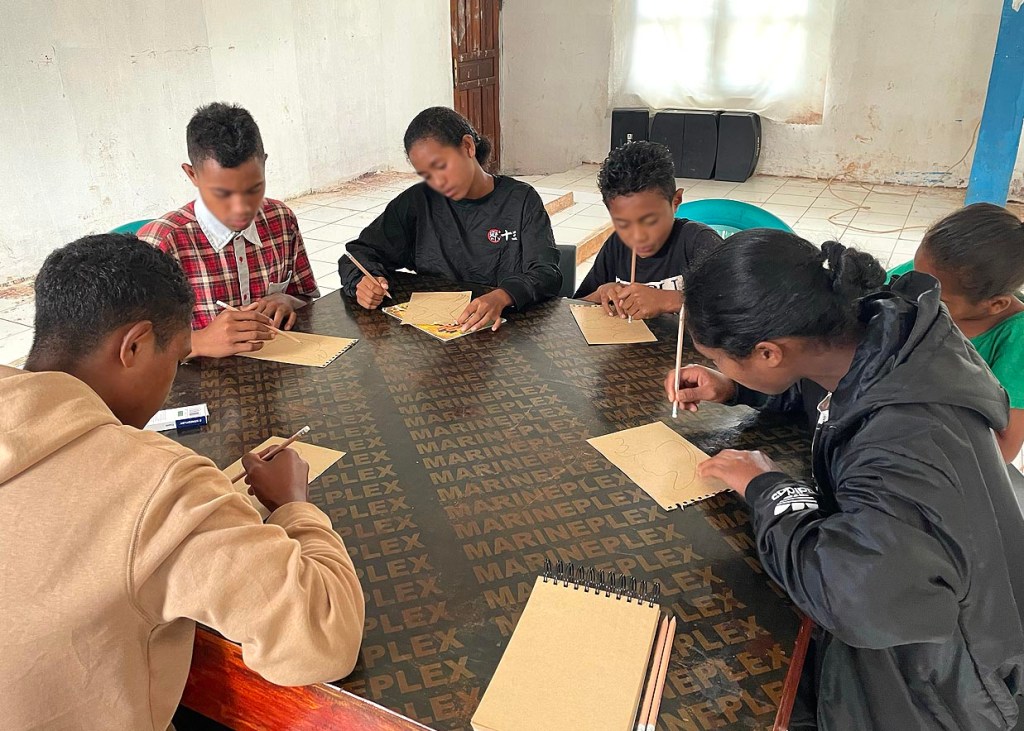
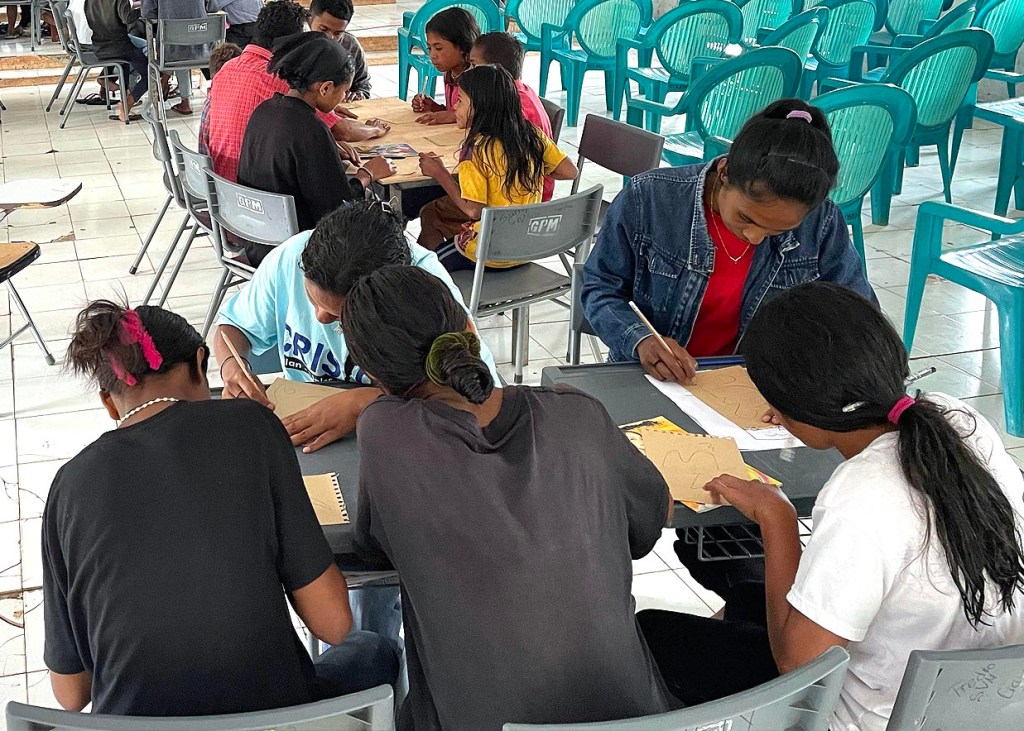
The workshop was presented to a group of students attending the Catholic Hato Builiko primary and high school and several teachers. Due to time and weather restrains the workshop was condensed into a half-day activity. On the morning of the workshop, it was unclear how many participants would show up. I had been unaware that the suggested date for the workshop was a public holiday and most students would be unable to attend. It was a very hot day and many lived in neighbouring villages. Despite this, people ranging in ages from 6-16 and and several teachers rocked up in dribs and drabs and the number of estimated participants exceeded expectations.
The activity was introduced in the following way:
Today we are going to exercise our brains and our imagination – our creative thinking skills to solve a very small problem. A tiny fun problem. While we solve this tiny problem, we will be practicing the skills and strategies needed to solve very big problems.
I then introduced the big picture to provide context and set the scene.
What are the big problems facing the world today? Climate change.
(I drew a diagram using a large marker and sheet of paper fixed to the wall as I spoke). The world is getting hotter because we are putting too much carbon-dioxide into the atmosphere. The sun warms the oceans and changes the currents. This changes the movement of the atmosphere around the world which creates big storms, hurricanes, and droughts. It is complex and needs your imagination and create thinking skills to design new ways of thinking to survive and change. What are the big problems in Hato Builiko?
The participants indicated the need to design houses to cope with extreme weather and prepare for crop failure. These are big problems that we can identify but we can’t solve these big problem in one morning. So we are going to start with a tiny problem to get our creative thinking skills moving. We are going to resolve a picture using our eyes and brains.
Has anyone looked at clouds in the sky and seen a face or an animal or a dragon or a car?
You are exercising your imagination and perception skills. Now look at these lines and shapes on the page and imagine what you could draw incorporating all or some of the existing lines. Connect to create what you see. It could be an animal, person, alien, creature, landscape or a monster.
Let me demonstrate. Draw a series of random lines like the classic rabbit-duck illusion used by the science philosopher Thomas Kuhn to demonstrate a paradigm shift in the 1960s. Does anyone see an animal or a person? Someone from the audience connects the lines and draws the eye of the rabbit. I turn the paper to the side to reveal the duck shape.
Can you see another animal? Someone from the audience connects the lines and draws the eye of the duck.
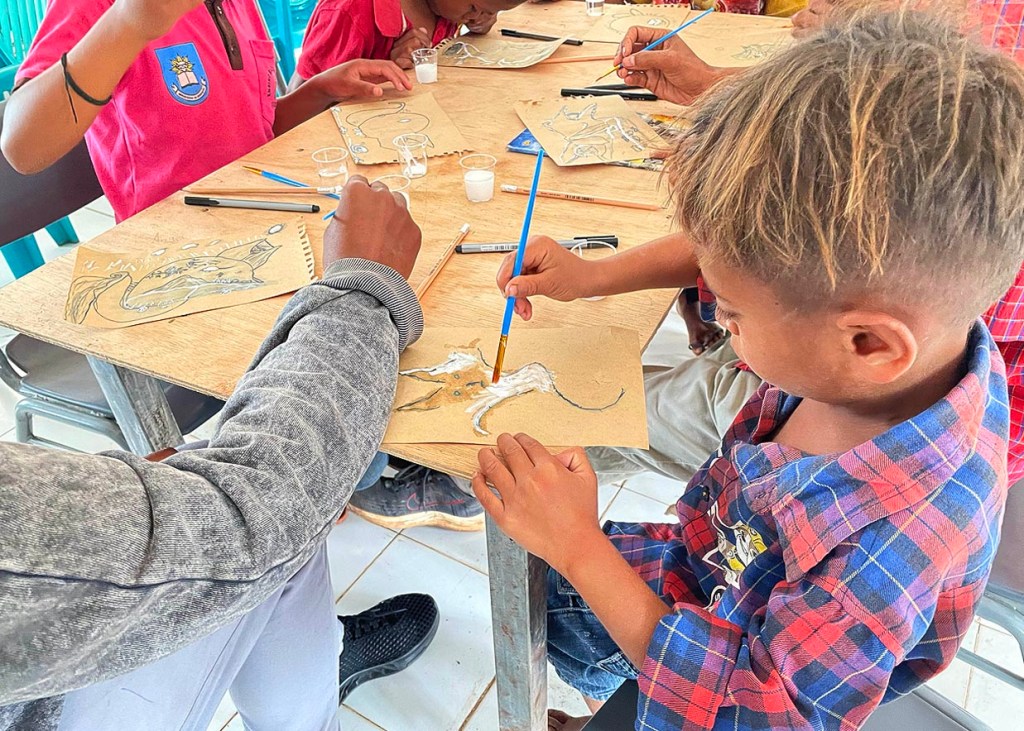
What can you see a fun character or an animal or a creature in your squiggle? Develop a character to help tell a story. We will learn some drawing and painting skills and learn how to tell a good story.
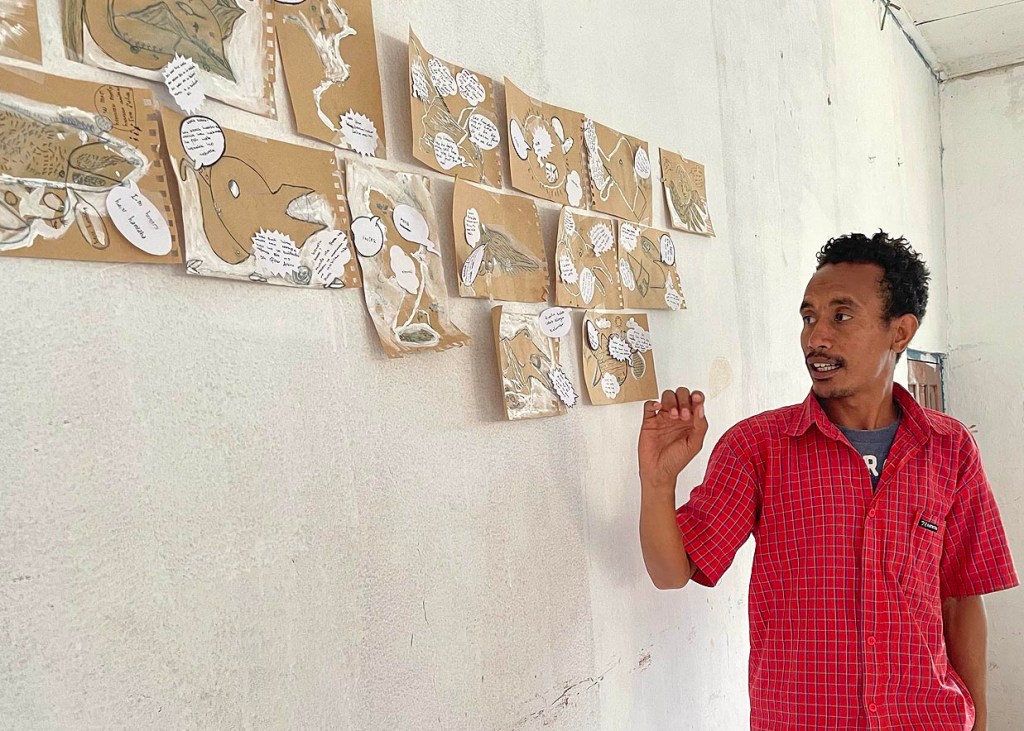
We are going to all get a unique “squiggle”, and a pen and find our own unique character. There is no right or wrong answer. Then we are going to give this character a voice so they can talk to us and tell us their story. What is on their mind? How can we help them?
A translated copy of the Visual Storytelling workshop notes was given to all the teachers before we began. The teachers joined in.
Reflection – what to take into consideration for next time.
- With no Tetun language I relied heavily on the translator to translate directions and let me know what participants were saying.
- A smaller group of learners at similar stages would have been easier to manage and get cohesive stories.
- The session was too long in one location. It would have been good to break for food and then resume with a more directed storytelling session after they had warmed up with a squiggle and started the conversations.
Objetivu no Rezultadu:
Atividade ida ne’e mak kria hosi estóriamentu vizuál ho objetivu atu fo kontribuisaun ba estudante sekundáriu ho nivel deseniu ne’ebé diferente. “Squiggling” (desenhamentu livre) hetan atensaun husi estudante sira nia kompriendimentu kona-ba perceptaun vizuál no demostra importánsia ba aprende atu ‘hare’ no hatene kona-ba oinsá seluk hare, atu komunika efetivu. Atividade ne’e explora deseniu liuhusi linha, tonalidade, destake no padrões, wainhira dezenvolve karakter hosi imaginasaun. Karakter sira sai baze ba estória ne’ebé uza konvensaun komik no estóriamentu liuhusi diálogu. Atividade ne’e gera amplu variedade resposta no abordajen vizuál imaginativu. Nia fornese demonstrasaun ba prosesu kriativu no oinsá dezenvolve sketsa no ideia rudimentár to’o ilustrasaun final. Estóriamentu fó estudante sira hanoin no maneira atu interaje ho seluk iha ambiente seguru.
 Improdraw