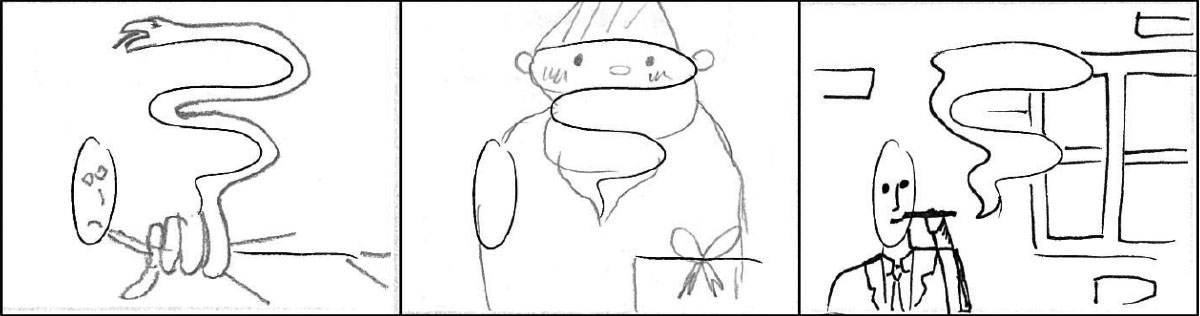
Squiggling is a form of projection. Norman Hetherington developed this projection technique in the popular ABC television show, with his puppet from out of space, Mr Squiggle. Mr Squiggle found or ‘saw’ images in a few random lines and shapes provided by children each week. He used Mr Squiggle’s broom handle hat to ‘drive’ the pencil on his nose. Hetherington was positioned above the set looking down, so his drawings, that were drawn the correct way from his perspective, appeared upside down to the audience. This added greatly to the audiences’ visual journey and the stories visual punchline.
Squiggling became a cheap and accessible drawing game that everyone could play. All you needed was a piece of paper, a pencil, and a few lines and shapes to get started. As a child, the challenge to find a picture in the squiggle was so engaging I could do this for hours.
The psychiatrist, Winnicott (1971) used squiggles in his therapeutic consultations with children This psychoanalytical technique, aimed to find meaning and links to psychological problems of his patients. Using squiggles in art therapy is still promoted as a form of art therapy. Steinhardt concludes in The Eight Frame Colored Squiggle Technique;
The (squiggle) technique also can reveal sources of strength and creative potential in a client for finding solutions and directions, and for suitable treatment interventions.
However, the value of using squiggles as a psycho-analysing tool has been disputed, but the process of the game still holds some value in creating a non threatening, fun environment where discussions between a child and their therapist can take place. My thesis, Back to the drawing board?, explores the value of a speed (timed) squiggling activity to promote, demonstrate and experience creative thinking and iteration.

The main squiggle exercise consists of the following 3 steps.
- Students are given a squiggle to search for as many ‘pictures’ they can see, describing these in a few words, creating a list.
- They then draw what they saw from their list. Once the initial images have been drawn they are then asked to draw any additional images they have subsequently thought of. Once they have exhausted all possibilities, they then select their ‘best’ picture ie: most ‘creative/unusual/clever/surprising/original’ squiggle response. It may not necessarily be their neatest or best-drawn response.
- They are then directed to consider where in their ideation process did they produce their best ‘picture’?
The fluency results of the Speed Squiggle activity reflect the results of McKim’s ‘Thirty Circle Exercise’. The best, most surprising, or clever responses are generally created in the later part of the creative process therefore promoting the need for judgment free iterations. This activity demonstrates the need for visual communicators to understand the principals of visual perception; the need for iteration to achieve originality or ‘surprise’ in the audience; and the need to visualise ideas on paper (or tablet) to realise their potential quickly. It also demonstrates the level of drawing ability needed to communicate an idea is within reach of most people. To communicate through drawing, as with handwriting, you need just enough skill to form ‘marks’ that make sense to the viewer.
 Improdraw