Ranger Read: A pathway to reading success for your toddler
Ranger Read is a phonics-based reading program developed by Ian Moore and Dr Janet Saunders. It uses current research into phonics education with an emphasis on experiential learning utilising all the senses. Janet uses her experience developing learning resources for the Curriculum Corporation of Australia (while employed by the Center for Design, Research and Education (CADRE design) alongside her recent Ph.D research and extensive design and application of workshops and learning resources for WSU undergraduate students, high schools, and community groups in Western Sydney, Timor-Leste and Tanzania. Currently, she is completing further education with ACU to ensure Ranger Read aligns with the recent changes to phonics education in Australian schools, working towards accreditation of the program. Janet was recently awarded Excellence in Teaching Award, 2025, NSW Teachers Guild.
Want to be part of this exciting project? Open Doors Learning is hosting a free 6-week Ranger Read pilot.
FREE Tuesday morning: Starts 11th March, 2025.
9.30 – 11am – under 2yrs, “Playtime with a purpose”, plus morning tea
11-12.30 – 2-4yrs “Prep preschool: intro to word building through phonics activities”, plus morning tea
FREE Ranger Read Pilot, 2025
Why Ranger Read? Device led teaching often omits the import role that other senses play in a child’s ability to learn how to read and spell. The Ranger Read program calls on ALL the sensors, not just auditory and visual, to heighten the experience and strengthen memory retention. Ranger Read is more than an alphabet sounding and word building program. It is an unfolding story that brings “logic” to the many rules of English that make no sense and are difficult to remember (especially when English is your second or third language). The program empowers parents, grandparents and carers to incorporate creative activities and strategies into their day to help their children, and those in their care, to build confidence and a deep understanding of words and their relationship to the world around them.
The Ranger Read story is set in the Alphabet Wild-life Park in Africa where Ranger Read has come to help the creatures reach their full potential. He meets the family of shopkeeper owls (vowels) and the animals (consonants) who introduce themselves and their “main” sound. (Young people often start their alphabet journey learning the “name” of the letters rather than the sounds they make. This can cause confusion before they even start.) Ranger Read and the creature decide to put on a festival to showcase their talents and practice the word building and reading skills that Ranger Read has taught them. Each creature has its own personal story that includes a realisation, overcoming barriers, and finding friendship and joy with other creatures. Janet and Ian bring their storytelling skills to produce a series of fun, immersive lessons to life.
Playtime with a purpose: If you are under two years of age, you will meet the owl puppets (the vowels) and the animals (consonants) as part of this exciting story. Fun games like hide and seek, matching balls, smelling and tasting food, singing, clapping, making and moving engage all the senses as you journey with Ranger Read. If you are over two you will engage in lots of fun activities designed to instill a love of stories, language and words, locking in your understanding of the building blocks of reading and spelling for life-long learning.
This program is also designed to empower parents, grandparents and carers to add creative “learning bites” or “mini sensory activities” and “brain boosting fun” throughout their daily activities and develop an enquiring mind in their child. Learning doesn’t just happen during “Ranger Read time”—it sneaks into snack time, bath time, and those random dinosaur impressions your toddler insists on doing at the dinner table. Ranger Read expands your child’s immediate environment while building strong bonds with family through shared positive experiences.
Eg: Grandad is mmmmmowing the lawn and encourages his grandchild to make the “mmmm” sound of the mower’s motor. When the grass is cut, they sit with eyes closed and touch and smell the fresh cut grass. This creates a strong memory of time spent with Grandad in his adult mowing world. Grandad suggests they could “pretend to be cows and moooooo while and eat the grass, “mmmmm”. Create opportunities to be silly.
Toddlers learn best when you’re in the action – playing, laughing, and making silly sounds right alongside them. Ranger Read gives you the skills, games, and playful mindset to turn every moment into a learning adventure. (Bonus: You might just become their favourite playmate!)
Memory aids, rhymes and visual tricks are sometimes taught in schools, but Ranger Read embeds them in the imaginations of the children as they become involved with the characters in the world of the Alphabet Wildlife Park. Toddlers learn the basic building blocks of language, such as the short and long vowel sounds, consonant sounds and unique combination of letters to make different sounds. Parents, grandparents and cares can continue the fun and learning at home. Young people learn best when adults jump into their world—so get ready to roar like a lion, waddle like a penguin, and act out silly sounds right alongside them!
If you and your toddler are interested to join this 6-week free pilot program please contact Janet on 0414769315.
Ranger Read background story
The award-winning teacher, Ian Moore, developed an early reading program called Dr Do Read. In 2006, the program gained traction and was hosted by the educational toy store, Kidstuff, in Sydney, Australia. Dr Do Read was an English language phonics-based reading program that emphasised a love of learning through stories, directed play and collaborative activities. The story that flows through the activities was set in Africa and focused on developing oral, reading, and writing skills for young learners.


The program has been developed into a series of resources designed for bi-lingual learners in remote communities that lack reliable internet access with the help of Dr Janet Saunders. Her prior experience designing and producing learning resources for the Curriculum Corporation of Australia and New Zealand while employed by the Centre for Design and Research in Education (CADRE design) positioned her well to evaluate Dr Do Read and research and trial ways to bring the essence of the program to a new audience and learning environment. The new program, Ranger Do Read, provides a progression of reading materials that gradually introduce more complex language concepts. Other similar programs such as Letterland, Jolly Phonics and Storytime Phonics also present stories to introduce letter-sound relationships and decoding skills, however Ranger Do Read provides stories aimed specifically at each community with a translation in the alternative language providing confidence to teachers who also struggle with English themselves.
Ranger Do Read aims to provide a viable pathway to teaching English for teachers who struggle with English pronunciation themselves in a crowded classroom environment with limited resources. The So They Can infants and primary (equivalent) schools in Kenya and Tanzania have many advantages over other publicly funded schools in the same areas however they too struggle with teacher shortages, large class sizes and access to appropriate resources. Access to reliable internet is a constant problem so relying on online resources is not viable for most of these schools. Although a few So They Can supported schools have access to tablets and the popular KitKit School program, this resource is best used with self-directed learners and requires constant technical backup. Storage of resources away from the harsh elements and the inconsistent availability of water for cleaning also effects the type and longevity of resources used in some of the more remote schools. The Let’s Read book exchange program also provides these school with a constant supply of good quality books which support the lessons taught in the Ranger Do Read program.
As an experienced illustrator, Janet has developed an illustration style to resonate with children and teens. During July 2023, a draft alphabet which incorporated illustrated animals and bird characters was quickly developed and trialled with several schools during the visit. Would the students recognise all the animals and birds?
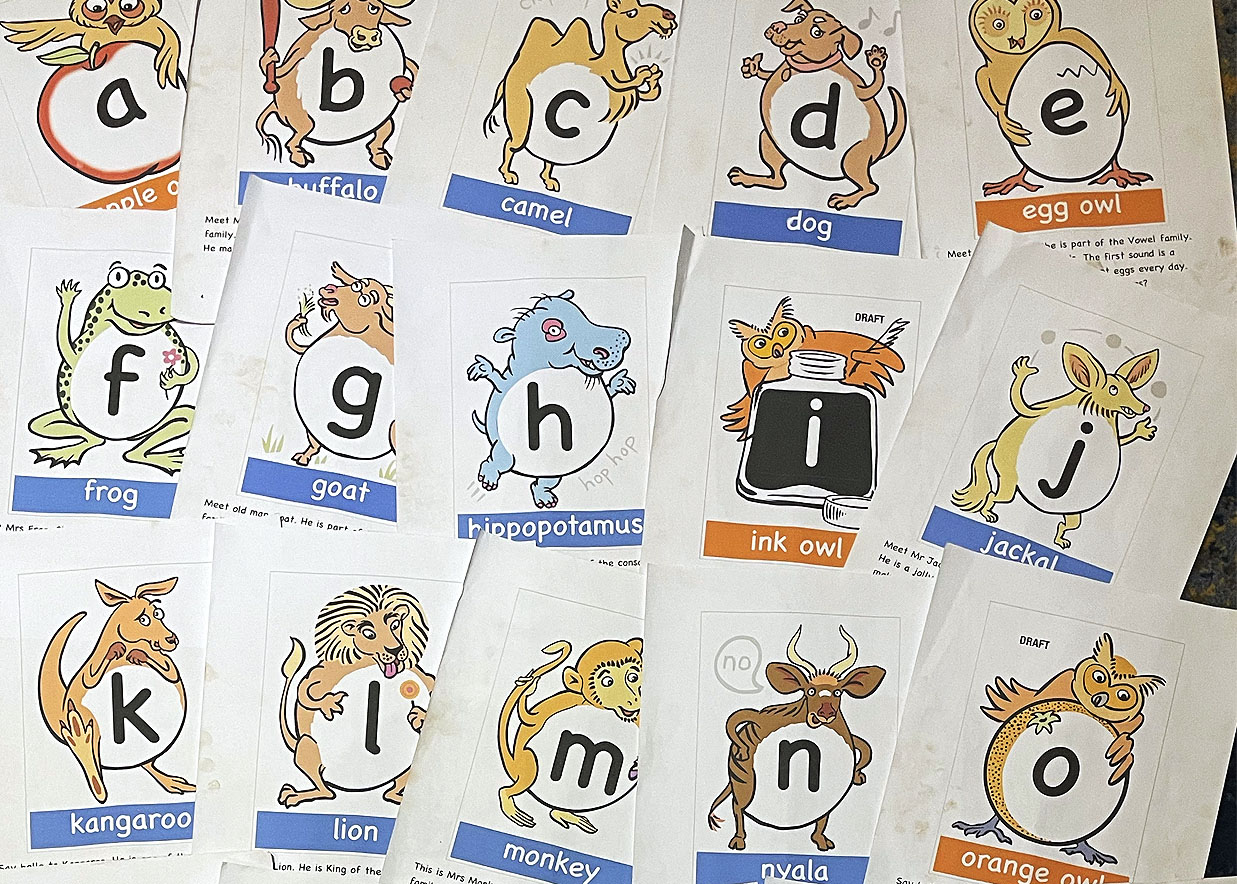
Some animals were changed and adaptions to the level of stylisation has been made so each character retained some realistic features so that students could make immediate visual identifications with the image and the word. Although the demonstration lessons conducted by Ian Moore were brief, a lot of information about the suitability of the proposed resources was gained during the delegations visit. Through simple observations and questions Janet discovered what content and formats might work and what wouldn’t be appropriate. Janet has begun designing a series of large (A4) double sided flash cards which would be the first resource introduced to the learners. She made amendments to the stories and illustration drafts on her return and this process will continue with consultation. Another important observation she made was the need for a Swahili translation. All the words, stories and games could have Swahili translations alongside the English. This would be smaller and less prominent than the English text but would provide communication confidence to older learners, teacher trainees and teachers where speaking English is a challenge.
 Improdraw
You must be logged in to post a comment.